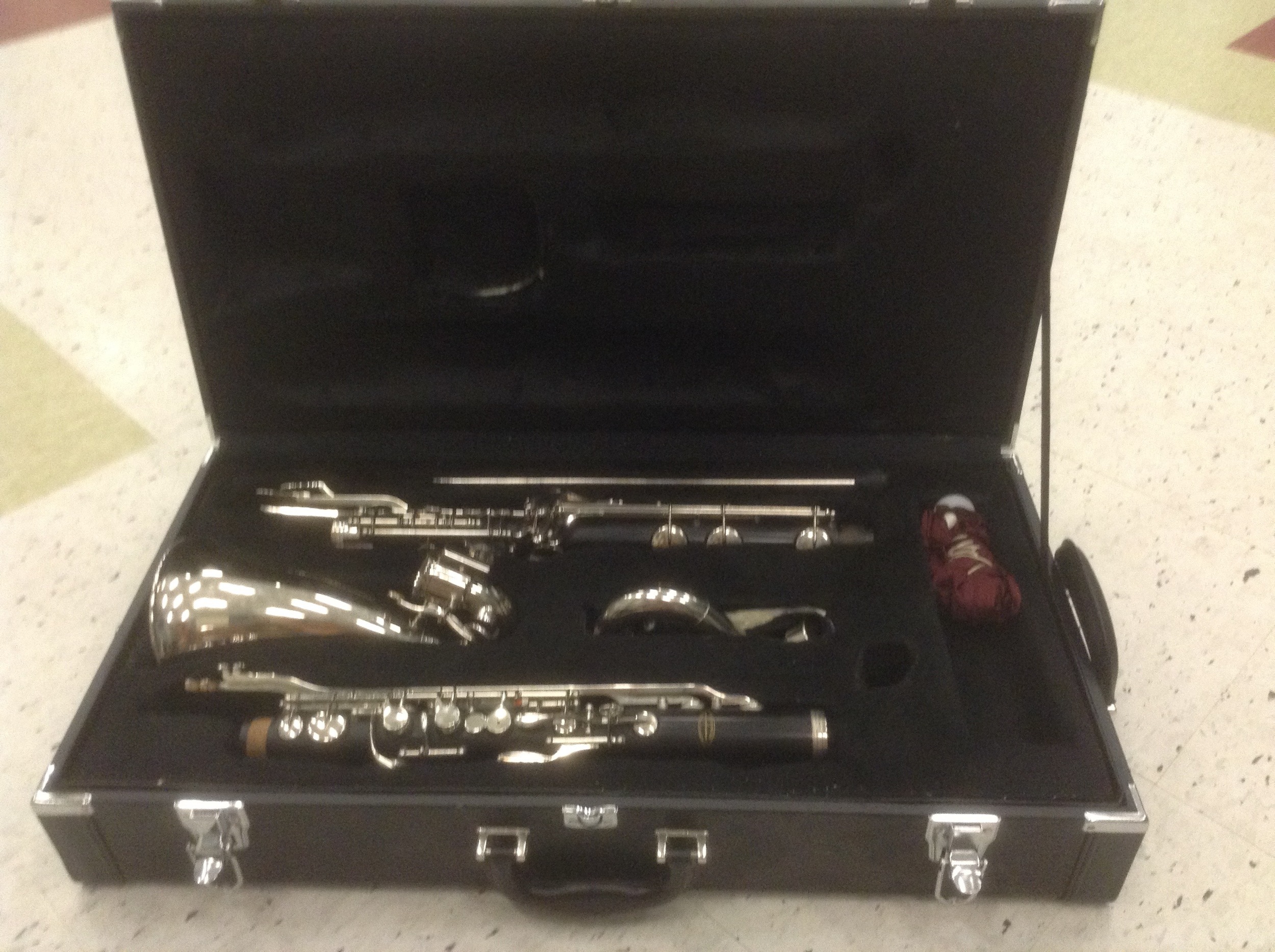
Tempest Bass Clarinet Review

One of the first wind instruments I tried to acquire when I started at St. Croix Prep was a bass clarinet. It was a good choice because I had enough clarinet players, the transition to learn the instrument is not too rough, and it helped reinforce the bass lines in our music. The first instrument we got was a loan from my dad's school. We used it for two or three years (makes me wonder how many schools have extra instruments sitting around--I know I've had some things spare in the past couple of years) before I had the school purchase a Selmer 1430P. There are many good reasons that that model is one of the standards for schools. It has a solid tone, its durable, and the low-Eb key is on the body. The one the school owns has performed well for several years now. After returning the loaner to my dad's school, though, I needed to get a second bass clarinet for my school. Trying to save some money and intrigued by Tempest Musical Instruments, I decided to go for their bass clarinet.

First, what is distinctive about the Tempest Bass Clarinet? The body is two pieces, the neck has a tuning adjustment, and the octave key mechanism is more complicated than the Selmer.

Especially when the corks are new, the bass clarinet can be challenging to put together. Trying to keep it aligned without squishing rods or bending keys is even more difficult for a student. 

For me as a non-clarinet player, it plays as in tune with as good of a sound as the Selmer. The upper register (up to C above the staff) plays easily.
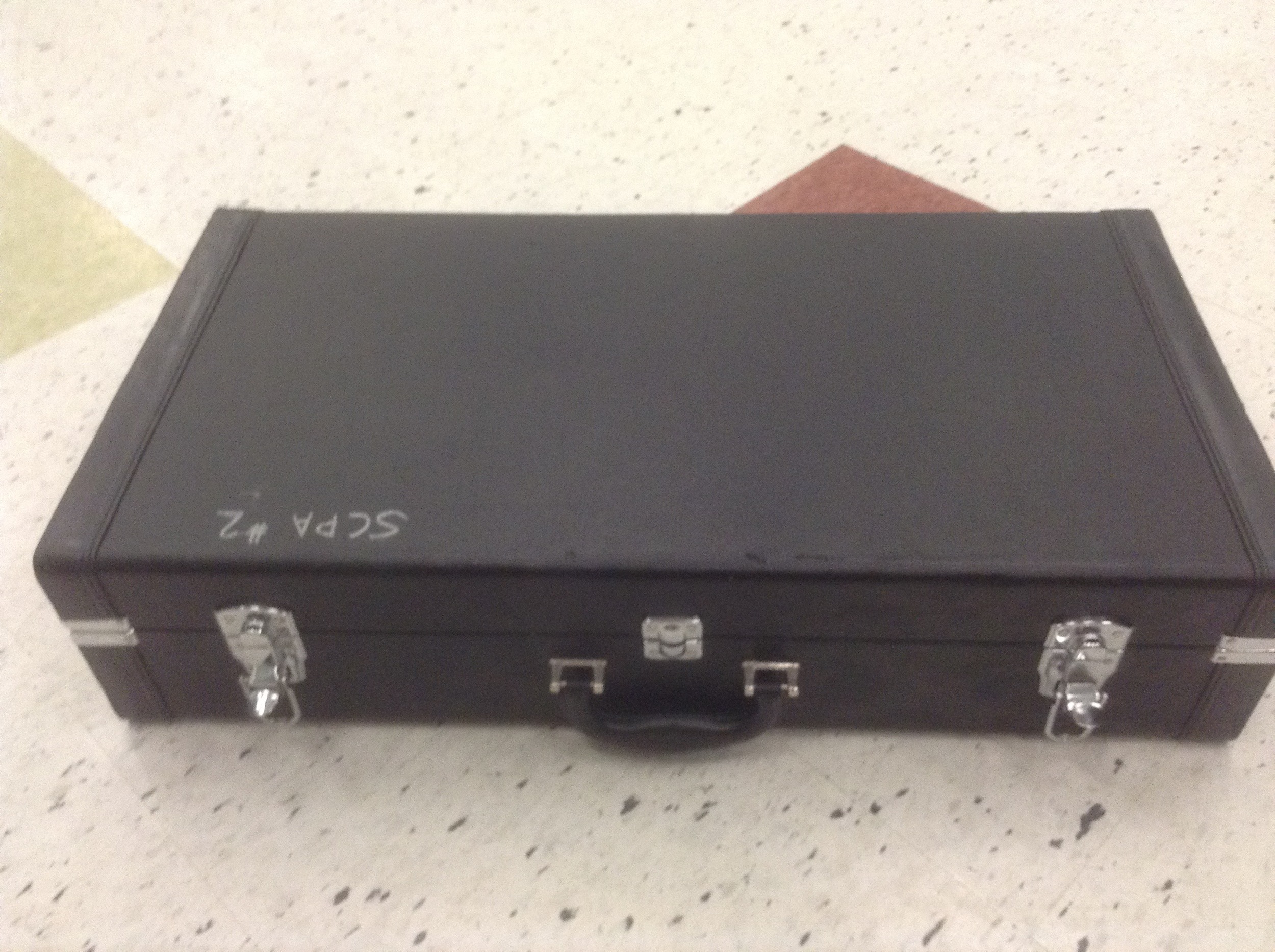
The case is okay. Since the bass clarinets pretty much live at school, I wouldn't expect it to take too much of a beating, but ours has quite a few nicks and scratches. On the inside, the soft covering has ripped away from the rigid foam padding underneath in a couple of places.

One thing I really like the screw on the floor peg. It has wings so that it is very easy to adjust.

Still, if I were going to purchase another bass clarinet for the school, it would probably not be the Tempest. While the features it has are advanced, none of them are necessary for the literature we play and some of the distinctiveness might be seen as negatives. Having a two piece body (with the Eb key on the bell) makes me nervous as a teacher because there is more stuff for students to mess up. If a student were really dedicated to the bass clarinet, I would recommend the instrument for them to purchase on their own. At $1600, I'm not sure there is anything else priced similarly that offers as much.

MMEA Performance

This blog entry is over four months late!

One of the highlights of this year at school was a performance in February at the Minnesota Music Educators Association Midwinter Clinic by the Symphonic Band. Last year's Symphonic Band recorded two pieces (Caprice by William Himes and The Fire of Eternal Glory, James Curnow's arrangement of Shostakovich) and I found out about the band's acceptance in the middle of the summer. Right away, I started planning the program...but when the year started, I found that a number of students, including all of the 9th graders I had expected, would not be in the ensemble I was left with an ensemble of 36 instead of the mid-40s, and several sections were short players. Add to this that all three double reeds were new to their instruments this year, and I knew the ensemble had a ways to go to be ready.

From the start of the year, I tried to impress upon the group the need to make every note count. We had to play everything with meaning and precision, and we couldn't do this without truly listening. A performance early on in the year (on Halloween) for the other 7th and 8th graders helped put the group in a concert mindset, and our first evening concert in November got some of the works for MMEA ready. As I thought about the program more, I knew we needed to do some special things to make the program meaningful.

First, I had planned all along to write a new piece for the band. This had to wait until December and my winter break...more on that later. Second, I asked saxophonist Greg Keel if he would be willing to appear as a soloist with the group, and he agreed. I had one piece in mind for him as an improvisor and set to work trying to find another. The first, Lissa Fleming May's Reflexão e Dança is a Latin inspired tune that calls for the ensemble to create its own arrangement of the improvised section. Later, I found Basin Street Barbecue, a version of a big band chart for concert band. Greg sounded fantastic on both, and the students really enjoyed having him at the school to work with them on improvisation and having him play with us--as several students put it, he made them feel professional.

Because I waited until December to write a new piece for the band and because I didn't want to overload the program with difficulty, I kept the new work on the easy side. It's called St. Croix Valley Overture. Its not quite ready to post yet, but I hope to get to it within the next week. I was making edits up until the week before the performance and didn't finish all the tweaks I'd like to make it look nice.

Take a look at the final program. While not the most challenging program for a middle school band, it represented a significant accomplishment for the group and the school. For a band of 36 non-auditioned students in 7th and 8th grade to go to the state music convention and make the program sound good is impressive, and I was proud of the students.

Preparing for the MMEA performance pushed the ensemble farther than it has ever gone in technique and musicianship, and it remained one of the most memorable events for all the students through to the end of the year. Perhaps later I'll reflect on how the preparation impacted our rehearsals for the rest of the year.

summer starts! plans and reflections

With the start of summer, my mind jumps both to the next school year and to the things I could have done differently during the year past. I'm already listening to concert and jazz band music and planning how to make the best use of time in rehearsals and lessons. I've started making lists of goals for the summer and have planned out what I'd like to do with the blog and composing. Here's what I am thinking.

Read More