
Rhythm Game Roundup

I like games, and they can be a great motivator in band class. Rhythm is one area of fundamentals that is particularly effective when gamified. Today I'll share some sample games I use with my first and second year students that are simple, fun, and helpful.
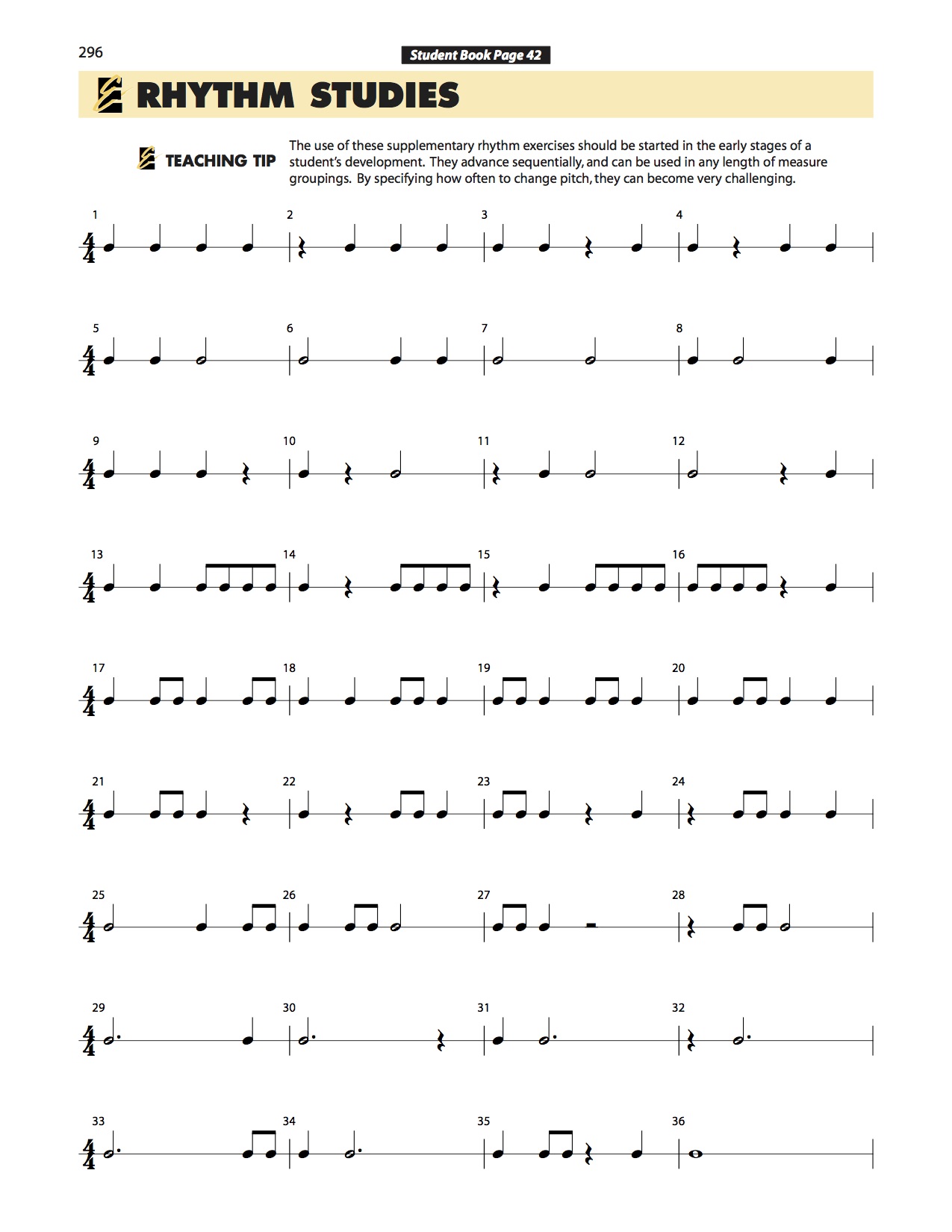
All of these games make use of the rhythm pages at the back of Essential Elements 2000 (books 1 and 2), but other rhythm pages would work fine as long as they are laid out similarly. It's nice that the EE book pages have a consistent four bars per line and progress from less to more difficult.

One other common piece of the rhythm games is the use of a metronome or some sort of background track--the drum loops in GarageBand can be particularly effective if you choose loops that emphasize the subdivision of the rhythms you are working on.

Rhythm Chain

There are two or three teams--usually I use instrument families (woodwinds/brass) or sections. On each team's turn, students take turns playing one measure at a time in sequence. The goal is to play the longest stretch of measures without any mistakes. Once a student makes an error (wrong rhythm, rushing/dragging, etc.), their team's turn is over, and they earn one point per correctly played measure.

Variations: students play more than one note per measure of rhythm, or each student plays the next note stepping up a scale.

Rhythm Finder

For this game, I give the students a range of measure numbers to look at (as much as a whole page). I perform a measure (usually twice) and the students write down the measure number on a piece of paper. I sometimes do this game in teams (or with partners) to help weaker students. After every five rhythms, I stop and have students check their work.

Variations: To make the game more challenging, I'll improvise a melody rather than playing a single pitch for the measure.

Rhythm Tic-Tac-Toe

Invented on the last day of school this past year, Rhythm Tic-Tac-Toe could also be called Rhythm Bingo or Rhythm Connect Four. You need two teams that are roughly equal in musical ability.

Draw a 4x4 grid on the board and label each row with measure numbers corresponding to a section of the rhythm sheet (i.e., pick four lines from the sheet). Teams take turns with one student at a time selecting and playing a measure from the board. If they play it correctly, mark the square for that team. The team that gets four in a row first wins.

Variations: Play until the whole board is complete. Make students play more than one note for each measure. Increase the tempo on the metronome.


Choose your own adventure: Mood/Mode

You’re the star of the story! Choose from 40 possible endings reads the cover The Cave of Time, the first volume in Bantam Books’s Choose Your Own Adventure series. About two years ago, I thought it would be neat to make a piece of music which was guided by choice. Mood/Mode is the first fruit of that effort. The piece consists of an introduction followed by eight possible sections which each represent a mood, an emotion reflected in the music. Each section is based on a different musical mode, a set of notes forming a scale and the basis of the harmony for that section. As the piece progresses, soloists cue the next section by playing a cadenza based on the mode for the next mood. If a mood is repeated, new material is added. Once the final section is signaled, ending music (different for each of the eight moods) is played. There are more than 16.7 million possible sequences for a performance, but at the premiere, we did just two (recordings below).

Mood-Mode Cadenzas.jpg

Each student received two pages for their part--one contained the introduction, selectable sections, and endings, while the other showed the eight modes used and a sample cadenza for each. The sections were color-coded (and labeled with the mode name and measure number) to make it easier to see how they were paired (and find the right spot more easily in performance).

The band only had about two weeks to put the piece together from start to finish, and I was still revising up until a couple days before the premiere. The most challenging part of rehearsal was helping the students know what section of the piece was coming next. The soloists did an excellent job of playing confidently and within the mode, but it was tricky to make sure the band would be ready to start playing as soon as the cadenza ended. I found that it helped to give some visual cues to the band (and especially specific players who started a section) so that we stayed on track.

Take a listen and let me know what you think about the concept and the music.

Mood-Mode 1
James DeCaro - SCPA Concert Band
Mood-Mode 2
James DeCaro - SCPA Concert Band

Educationally, there were several valuable things about this piece. It was great to feature student soloists and allow them the opportunity for some improvisation. Keeping the band engaged in listening was also good (and somewhat difficult!). For the future, I would love to spend more time on the modes to help students hear them more quickly. Also, depending on the ensemble, I might want to spend more time discussing the relationship between the modes and moods. With my current Concert Band, we have already done a lot of discussion on this topic (including a seminar on Plato's thoughts on the ways music influences emotions). I picked the moods based on what I hear, but others may not hear as I do.

If you didn't see it on the image above, here are the modes used:

  1. Octatonic
  2. Slavic Dorian
  3. Locrian
  4. Minor Pentatonic
  5. Diminished Whole Tone
  6. Whole Tone
  7. Mixolydian
  8. Dominant Bebop